Technical reports
Innovation is our key to success.
Many thanks to our suppliers for the products compiled on this page.
Reports from the trade press.
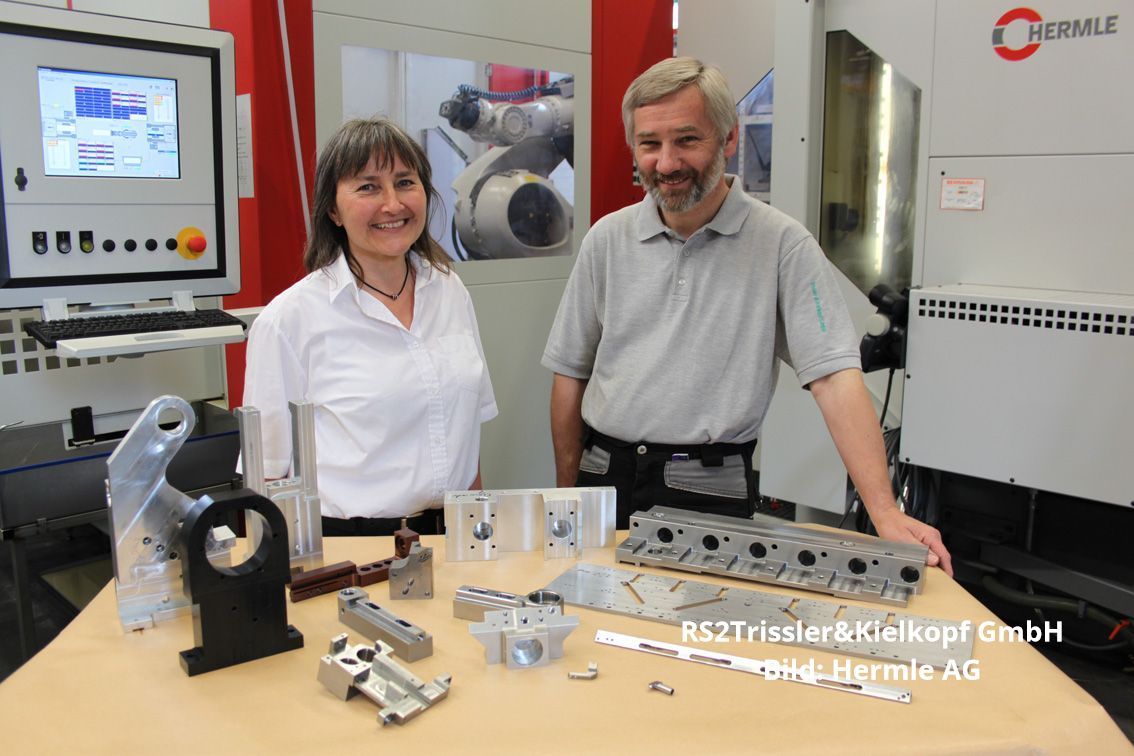
Hermle RS2-L
"Bound by nature"
User report from the company Maschinenfabrik Berthold HERMLE AG at:
Trissler & Kielkopf
laid in the cradle
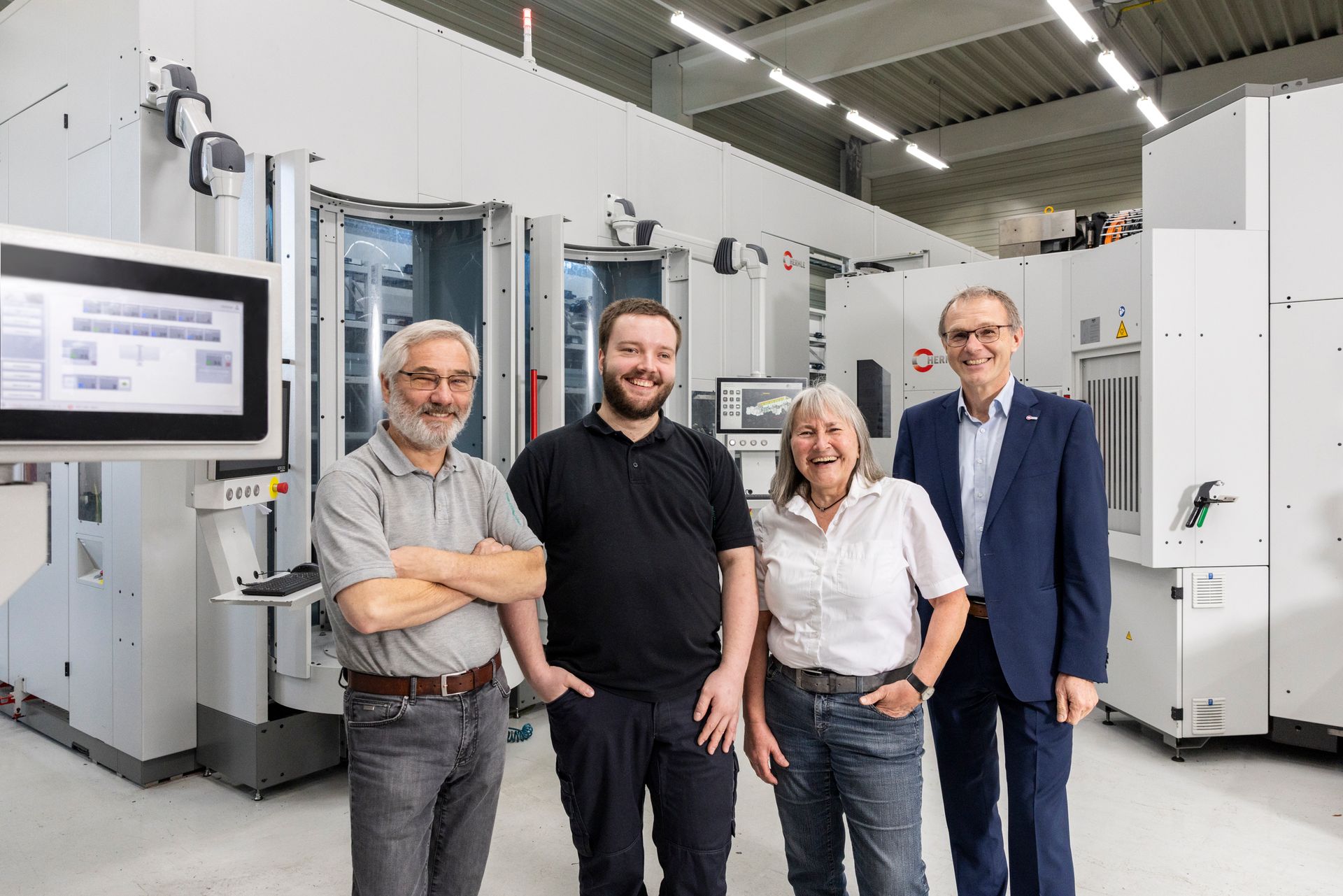
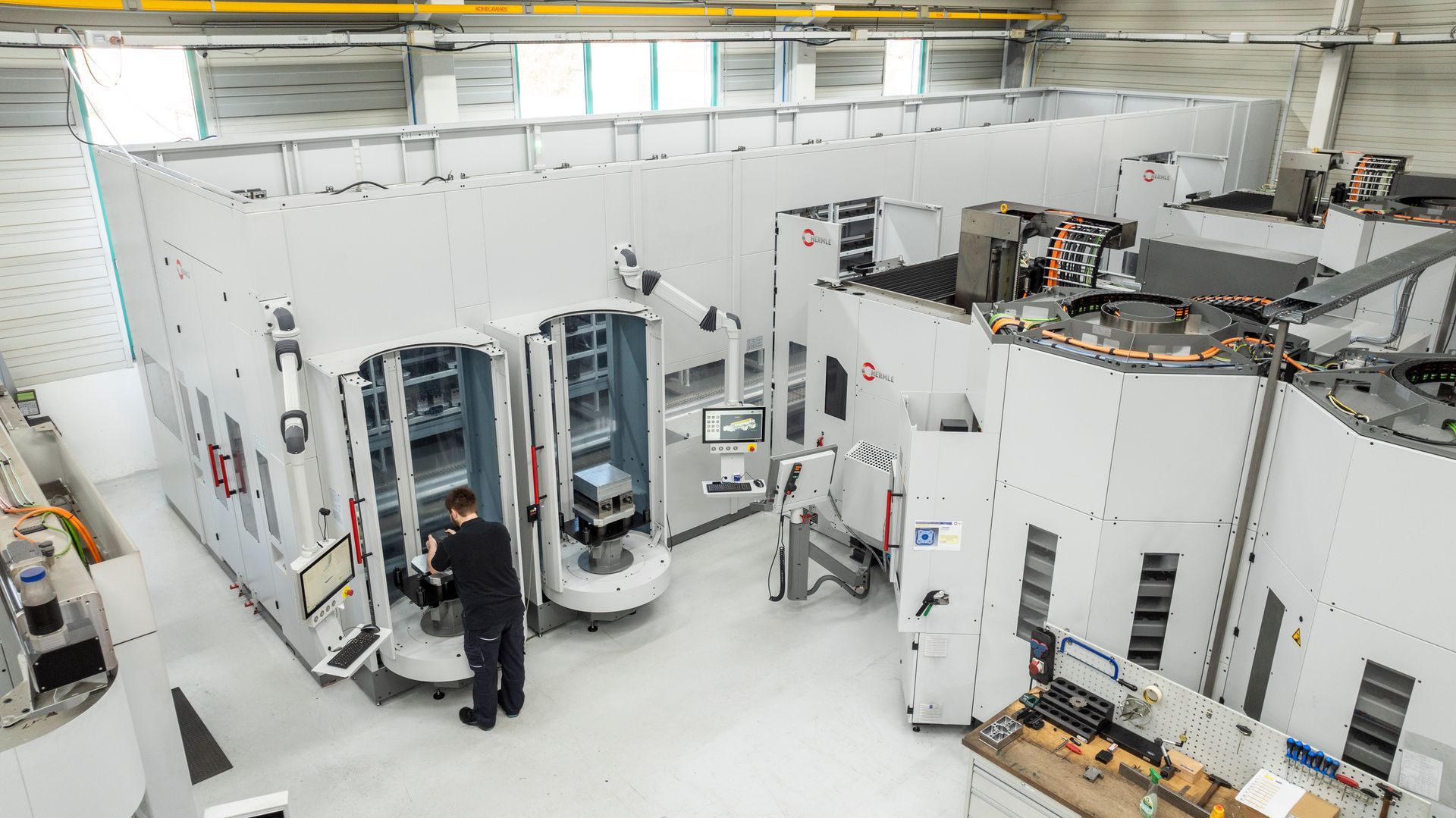
“The absolutely right system for a small company like ours,” says Managing Director Robin Dorau, describing his HERMLE RS L robot system with two integrated C 42 U machining centers. 150 pallets allow for 24/7 operation – starting from batch size 1. This is the only way for the contract manufacturer Trissler & Kielkopf to position itself for the future and develop further.
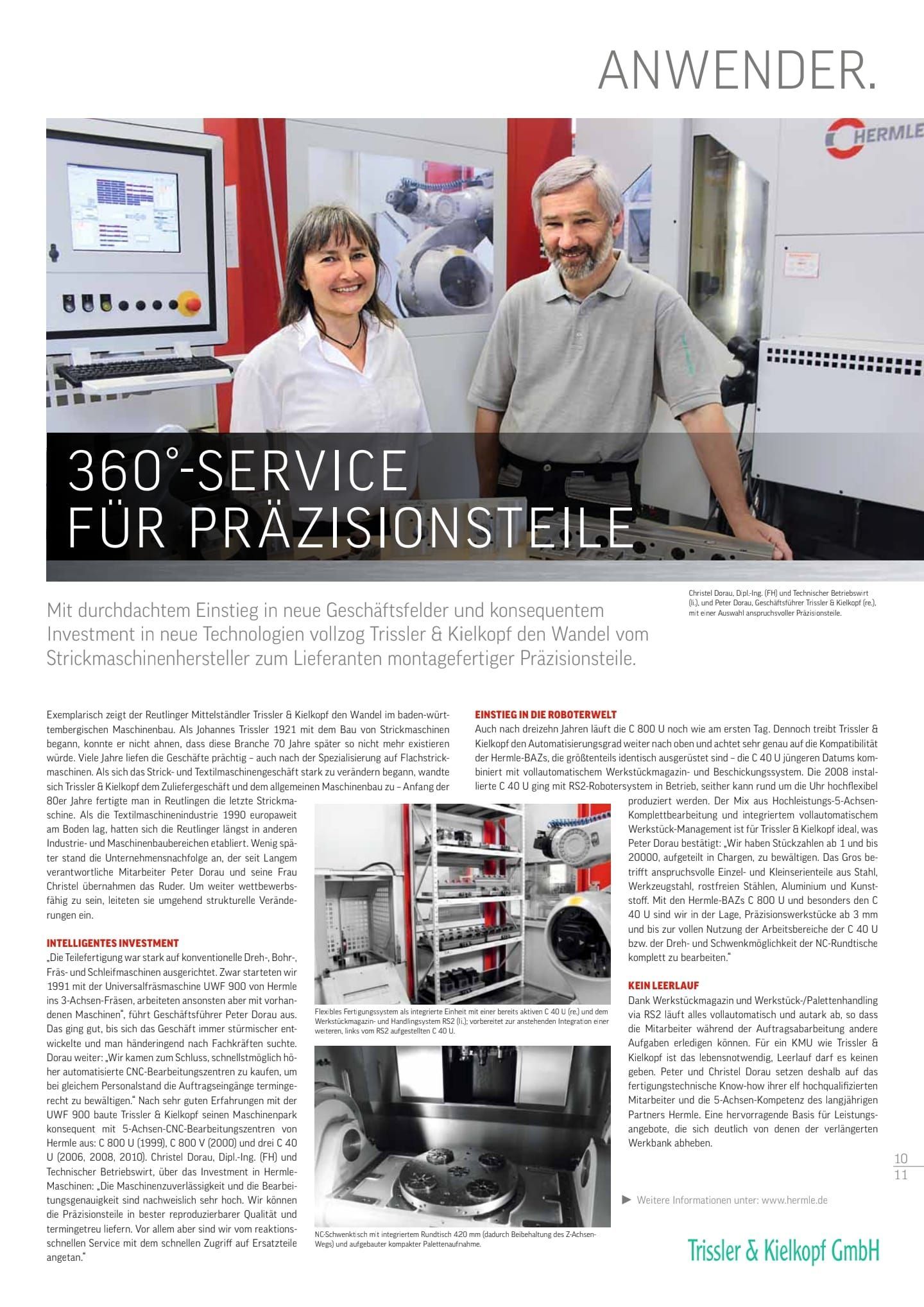
While browsing the HERMLE website, Robin Dorau came across a picture of the RS L robot system and was immediately captivated. "I wanted a system like that in my production facility," he recalls. The young man took over his parents' business two years ago and is now tackling the current challenges. The contract manufacturer has relied on machining centers from Gosheim since 1991 and on automation since 2009, for example with the HS flex handling system and the RS 2 robot system.
“Small robotic cells are a great way to explore the possibilities of the technology and gain experience,” says Robin Dorau. “But it was clear to me that we had to take the next step to become even more flexible.” His mother, Christel, adds: “In the Stuttgart area, we compete with many companies for employees – automation allows us to compensate for the shortage of skilled workers and produce without human intervention.”
From handcraft to high-tech
Christel Dorau, a graduate engineer, and her husband Peter, a master mechanic, took over Trissler & Kielkopf GmbH, based in Reutlingen-Betzingen in Swabia, in the early 1990s and invested in equipment such as the UWF 900 E universal tool milling machine from HERMLE. "We wanted a reliable system made in Germany; regional ties have always been important to us," Christel Dorau summarizes their considerations at the time. This meant that, in case of a problem, the distances were short and spare parts and technicians were quickly available. The quality and precision of the machining centers were, in any case, beyond reproach.
“We were the extended workbench for the mechanical engineering companies in the Reutlingen area and wanted to be able to deliver reliably,” she recalls. In the early days, they primarily produced small batches and custom parts for the knitting machine manufacturer STOLL, which is now part of the KARL MAYER GROUP. “Over the years, we diversified and now also supply industries such as environmental technology, special-purpose machinery, and the packaging industry,” says Christel Dorau. During this time, the couple expanded their machinery, adding, for example, two C 40 U, one C 22 U, and one C 42 U.
Formative childhood
Robin, the son, has been involved in the business from the very beginning. Just two weeks after his birth, his mother took him to the office. Later, his father sawed the floor out of his playpen to increase his son's range of movement. "I used to zoom around the production area in it," Robin Dorau reveals. He received his first HERMLE cap at the age of seven, and he still vividly remembers the in-house exhibitions in Gosheim from that time: "As a boy, I collected lots of pens there," he confesses with a mischievous grin. It was only natural that he completed his apprenticeship in his parents' company and subsequently earned his master craftsman's certificate in precision mechanics.
Small business, big investment
With his new responsibilities as managing director, he came a significant step closer to realizing his ideas. "We had already combined the RS 2 robot system with two C 40 U machines, but I wanted more," says the young entrepreneur. The company, with just under ten employees, was regularly reaching its limits in terms of pallet capacity. With up to seven clamping operations per workpiece and cycle times of seven to 60 minutes, the RS 2's 30 pallets weren't sufficient for 24-hour continuous production. "That's why I planned the linear system with 150 pallet positions," he explains. "Although we only work one shift, we want to be able to produce continuously even when no one is on the machine." Together with the HERMLE project team, Trissler & Kielkopf designed an RS L system to replace the existing RS 2 and, as required, to be even more efficient.
210 square meters of production space had to be cleared for the system, and HERMLE's technicians assembled it in record time. This was only possible thanks to the foundation-free installation of the machines and the modular design of HERMLE's robot systems. Two C 42 U five-axis machining centers are connected to the RS L robot system, each equipped with a double ZM 456 auxiliary magazine to supply the RS L system with sufficient tools. The contract manufacturer processes only steel on one C 42 U and aluminum on the other. "This eliminates the risk of contamination," emphasizes Robin Dorau. Two output stations allow skilled workers to load and unload pallets into the RS L. "The flexible system allows us to adapt it to new requirements at any time."
Examine and define processes
But there were also challenges: "We had to define everything in advance: the clamping devices, the tools, the processes," Robin Dorau recalls. "There's no more improvisation with this system; we accepted that." The SOFLEX-CCS (CellControlSystem) combined system controls the production process by triggering workpiece, pallet, tool, and fixture transports, transferring production data to the machine, and starting the automated workpiece machining. Of course, it also took some getting used to trusting the system. "It's like autonomous driving," the entrepreneur compares. "Who likes to relinquish complete control?" The company therefore invested a lot of time in thorough preparation until all definitions were clearly formulated and all data was entered.
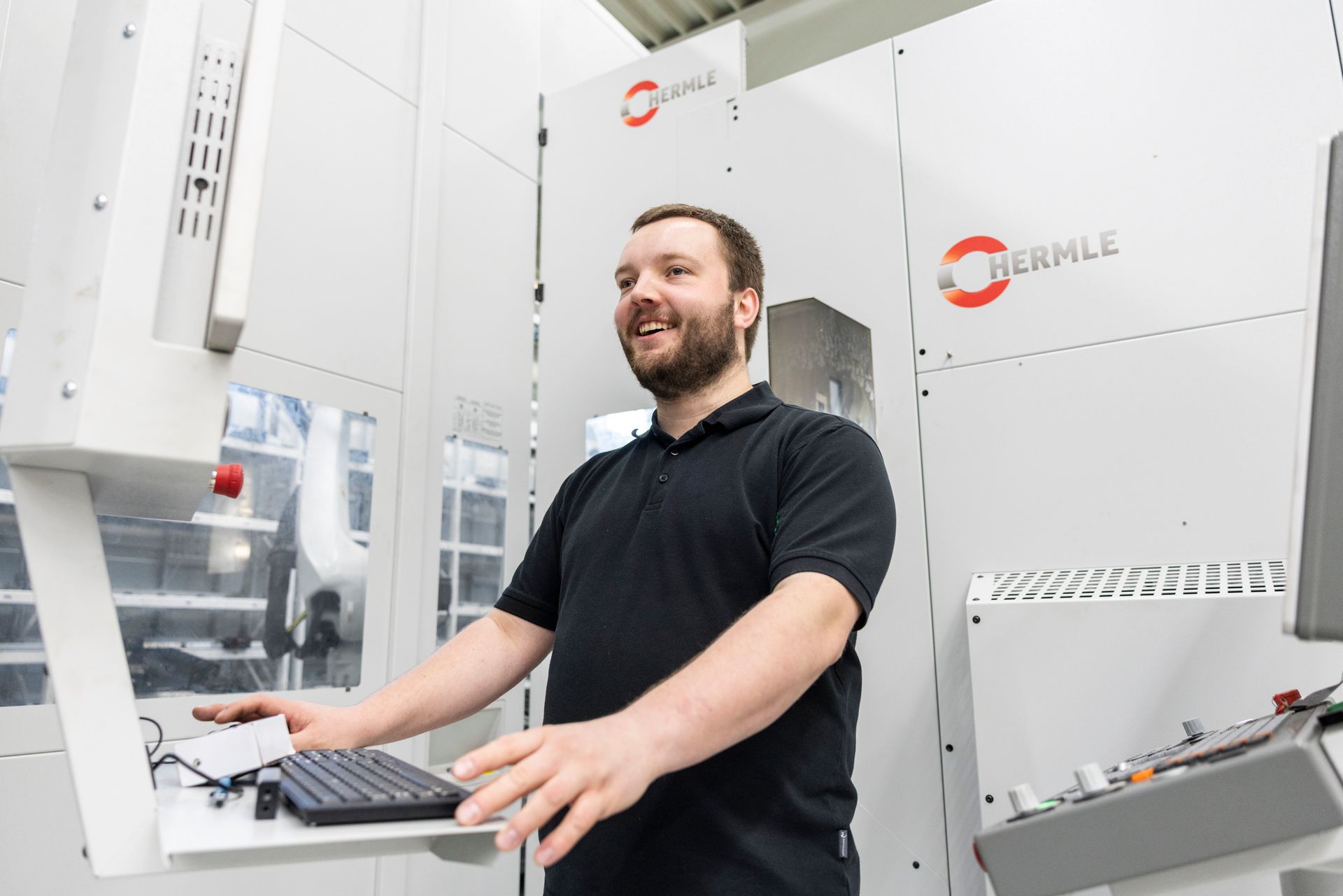
The effort has paid off; the processes now run like clockwork. Robin Dorau programs on the CAM computer, transfers the data to the machine, and presses the start button – without any manual intervention. "We've eliminated the word 'special' from our vocabulary," he emphasizes. "The entire process is stored in the system. When we manufacture a new part, we always assume it will be produced again. This way, we're prepared as soon as the follow-up order comes in."
One system, endless possibilities
A special feature of the system at Trissler & Kielkopf is that the SOFLEX robot control system also manages the tools. "This wasn't originally planned, but for me it was the only sensible option," explains Robin Dorau. "We discussed it with HERMLE, and three-quarters of a year after the machine was delivered, SOFLEX also took over tool management," he says. Since then, setup times have been significantly reduced again. "Load the program and five minutes later the machine is processing the blanks," he says with satisfaction. Unmanned night shifts are no problem thanks to the numerous pallets, individual cutting edge measurement, and breakage monitoring. "We've invested heavily to make all processes 100% reliable," says the managing director.
Was the purchase worthwhile? "It's even much better than I imagined," beams Robin Dorau. "When I ordered the machine, I wanted to gain an advantage with larger production runs starting at a batch size of 100. The first workpieces I processed were individual parts. And since then, I know that the RS L is completely convincing in this area as well." He's already thinking about the next two linear motion systems.
Prepared for anything
Robin Dorau: “The RS L takes a lot of work off my hands as an operator. I no longer have to worry about pallets or tools.” With the HS flex, there were recurring bottlenecks because, for example, there weren't enough fixtures of a certain type. Since they were only rarely needed, the company didn't want to waste space on them. “With the RS L, we have space for 150 pallets – and therefore enough capacity to keep even rarely used fixtures in the required quantity.”
Another important advantage is the elimination of downtime during loading and unloading. "That's five to ten minutes each time, which adds up over the course of the day," says Christel Dorau. "With an HS flex, we spend an average of 60 to 90 minutes setting up before a part is ready to run," adds Robin Dorau. "With the RS L, this step is eliminated thanks to the virtual machine. The time savings amount to 80 percent. Overall, we've been able to significantly increase our productivity and considerably extend spindle run times."
Tiltenta T7 with maximum equipment
Trissler & Kielkopf GmbH | TILTENTA 7-4200 | Area of operation: Contract manufacturing | Founded: 1921 | Headquarters: Reutlingen, Germany | Employees: 11
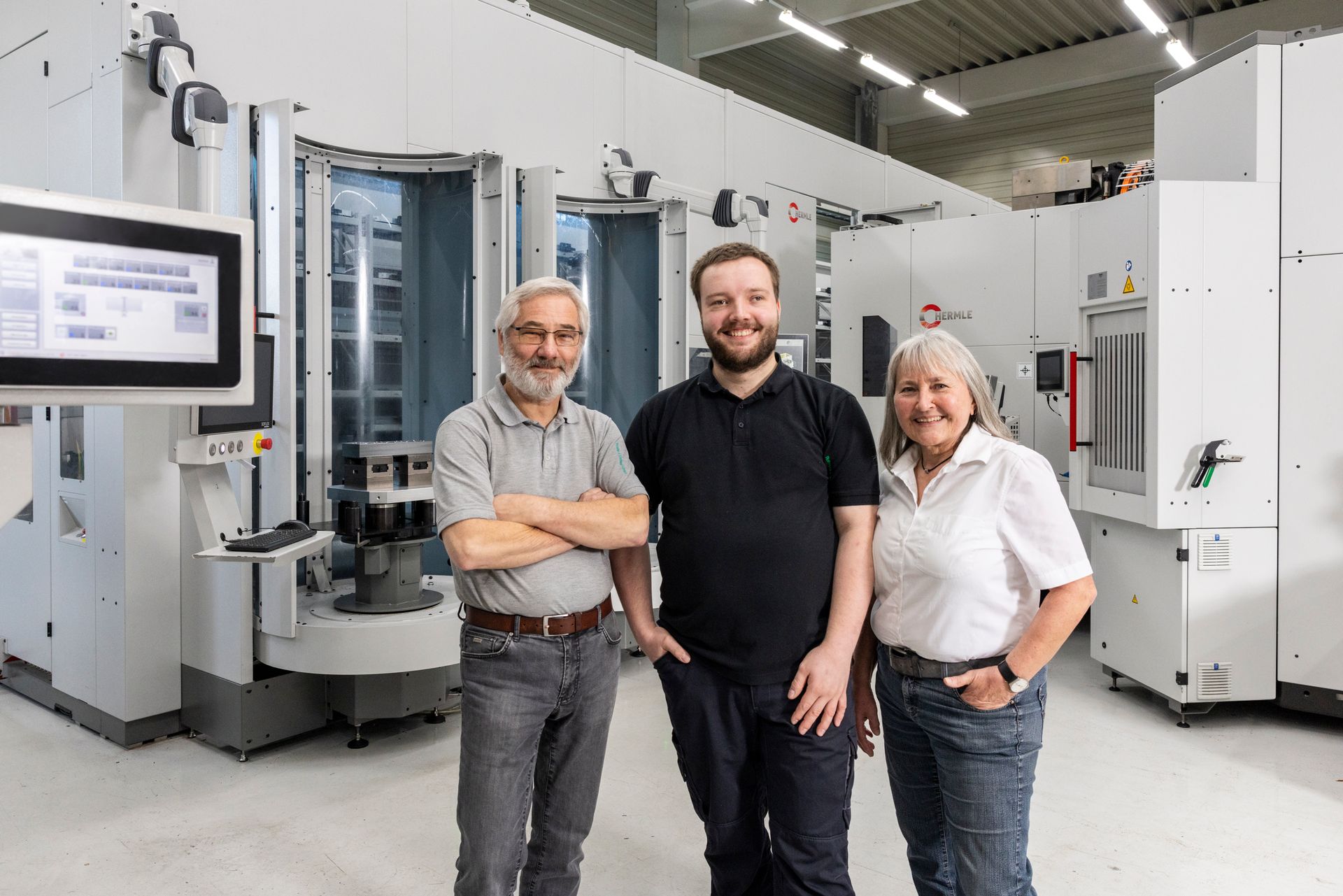
Trissler & Kielkopf GmbH is located in Reutlingen, at the "gateway to the Swabian Alb." Since the early 1990s, Peter and Christel Dorau have been managing the contract manufacturing company, which will soon celebrate its 100th anniversary. For 22 years, this Swabian medium-sized company has relied on machining centers from HEDELIUS.
Johannes Trissler founded the company in 1921 – initially as a supplier for Stoll, the knitting machine manufacturer also based in Reutlingen. When Peter Dorau joined the company in 1983, it was producing its own knitting machines, but was also engaged in contract manufacturing for the general mechanical engineering sector, in order to establish an additional pillar of the business in light of the structural changes in the textile industry. In the early 1990s, Peter Dorau and his wife Christel took over the management of the company.
Efficiency as the key to success.
The first years under the Doraus' leadership were marked by extensive investments: The machinery was completely modernized and ultimately found a new home in the larger production hall built in 1997. In the same year, the first two 3-axis machining centers from the North German machine manufacturer HEDELIUS, a BC 40 and a BC 100, were acquired. Two HEDELIUS C60s followed later. Peter Dorau had become aware of the manufacturer through a machine brochure. He accepted a personal invitation to Meppen and saw the machines in operation. He would not regret this trip.
“In the early days, price pressure was enormous. That's why we primarily produced serial parts back then,” explains Peter Dorau. The HEDELIUS BC 100 with pendulum operation was, in his view, the ideal machine for this. “The possibility of dual-station machining drastically increased our productivity,” he recalls. A partition wall created two independent work areas, which from then on enabled parallel machining and thus minimized unproductive time. Another advantage for Peter Dorau was the good accessibility of the work area: “Retooling the machine was always quick and easy.”
"A technically superb all-rounder."
Today, it is primarily the flexibility in manufacturing and the consistently high product quality of the workpieces that customers value about Trissler & Kielkopf. The HEDELIUS machining centers – currently four in operation – play a significant role in this: "We are a technically first-class all-rounder; everything from small to large production runs is possible for us," says Christel Dorau, summarizing her company's range of services. "Our goal is to continuously work with state-of-the-art technology and deliver consistently high quality to our customers," adds the former development engineer of a renowned technology group.
The customer base is now very diverse: From the packaging industry and environmental technology to special-purpose machine construction, customers from a wide variety of sectors rely on the quality work from Reutlingen. Demand has remained consistently high for years: "We've never had to actively seek out customers," Peter Dorau proudly explains. He has often heard new customers visit Trissler & Kielkopf's production facilities, saying, "Looking at your machinery, it's clear you're capable of meeting our requirements."
Trissler & Kielkopf is now even entrusted with the production of high-precision parts for research equipment. "We're not talking about hundredths of a millimeter, but ten-thousandths of a millimeter tolerance, and that's for parts that are a meter long," explains Peter Dorau. "Then we wrap them in tissue paper."
TILTENTA 7-4200 with maximum equipment.
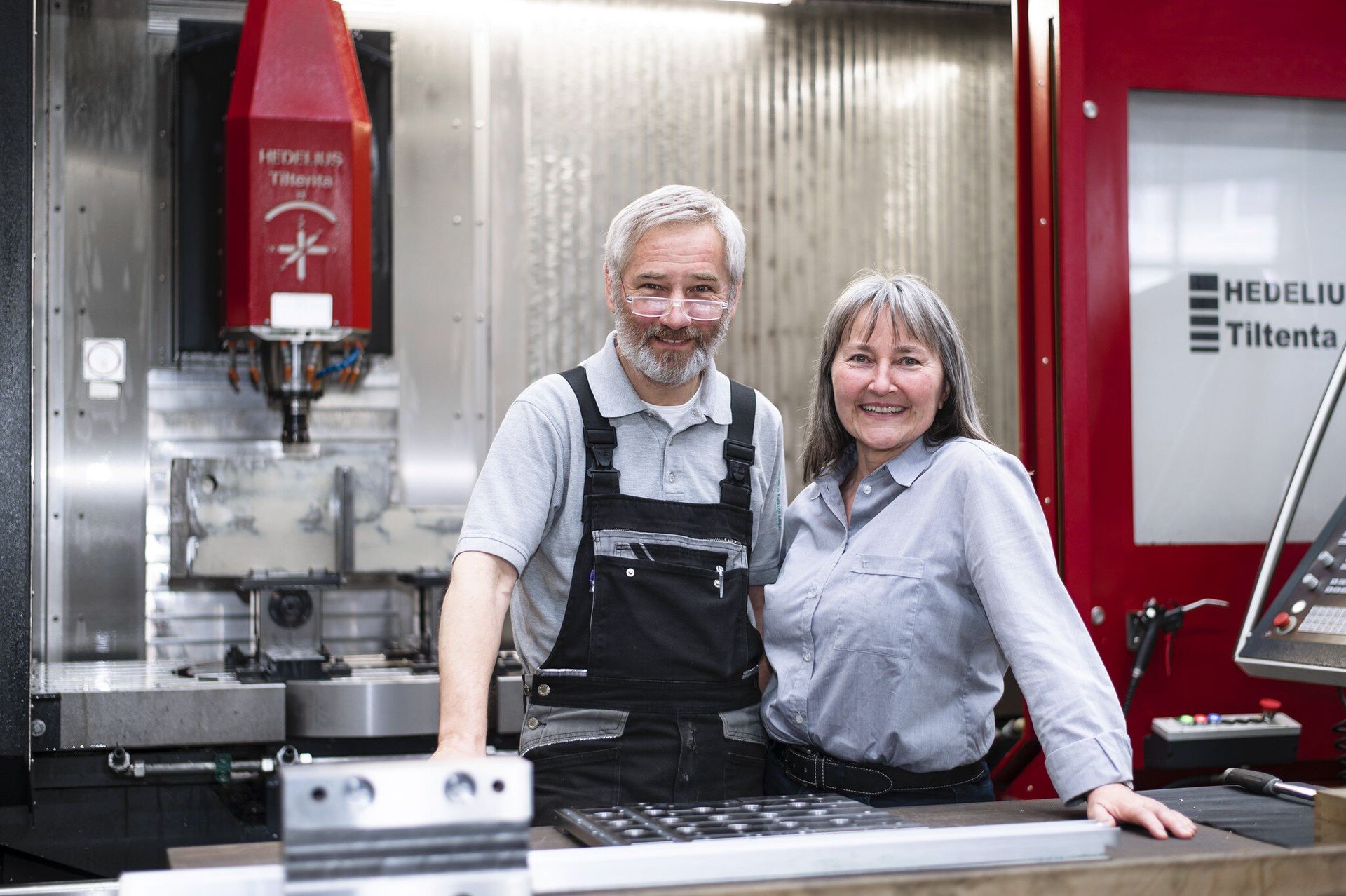
Given the high demands, the HEDELIUS Tiltenta 7-4200, acquired in 2017, delivers "consistently outstanding results," Dorau is pleased to report. With its generously dimensioned X-axis travel of 4,200 mm and a spindle speed of 18,000 rpm, this versatile 5-axis machining center with infinitely variable swiveling main spindle and integrated NC rotary table enables the flexible and accurate machining of a wide variety of workpieces. Even longer workpieces can thus be machined from all sides with the highest precision.
The TILTENTA 7-4200 was purchased to replace the HEDELIUS BC 100, which had served faithfully for twenty years until its replacement. It is therefore no surprise that the choice for the new machine fell once again on a HEDELIUS. With its comprehensive equipment package, the TILTENTA 7-4200 sets entirely new productivity standards: In addition to the already proven pendulum operation, a fast tool changer, a 190-position standby magazine, and a high-precision laser measuring system ensure further reductions in setup times while maintaining consistently high production quality. Four axes in the tool guarantee workpiece-independent dynamics – an ideal prerequisite for high rapid traverse rates and feeds of up to 40 meters per minute. These high feeds are supported by an internal coolant supply (ICS) at 75 bar pressure. Furthermore, the ICS minimizes tool wear.
Personal service is a plus.
Besides the compelling machine concept, another important purchasing criterion for the Doraus favored HEDELIUS: the competent and personal support. "The excellent service was a key factor in our decision to choose another HEDELIUS machining center in 2017," Peter Dorau praises the service technicians' commitment. "Whenever there's something that needs doing, we always receive quick and reliable assistance."
Trissler & Kielkopf currently employs eleven permanent staff members. However, they are desperately seeking additional personnel, as the skilled worker shortage has a firm grip on the contract manufacturing industry. According to the couple, one of the reasons for this is the immense competitive pressure, which is making the job of a CNC machinist increasingly unattractive to young people. "It's all too often forgotten that people should still be the focus, because it's people who have to operate the machines," they both agree.
A glance into the company's production hall quickly reveals that the two owners are serious about valuing their employees. For example, when purchasing the HEDELIUS TILTENTA 7-4200, they made sure the machine had an enclosed work area to keep the surroundings clean. Furthermore, to protect the health of the machine operators, all machines use mineral oil-free coolants and lubricants. "We want to offer our employees high-quality jobs and demonstrate that we can maintain them in the long term," emphasizes Christel Dorau.
Rubbing with brains
Rubbing with brains
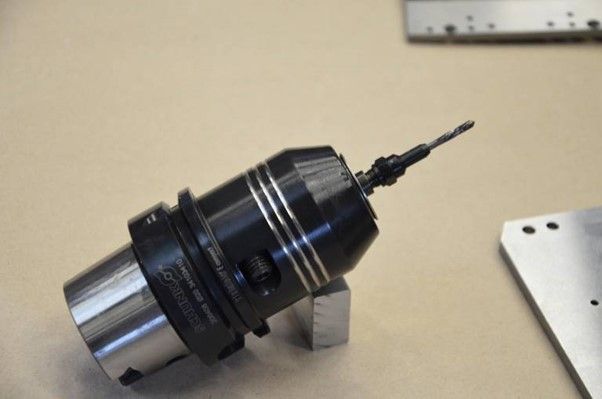
Productivity advantages with cermet high-speed reamers from HAM: Flexibility and rapid response to customer requirements are two of the strengths of CNC machining specialist Trissler & Kielkopf in Reutlingen, Germany. By using special reamers from HAM, the medium-sized company achieves significant productivity advantages: Tool life and machining times during the reaming process have each improved by a factor of five.
04.03.2014
User information
Trissler & Kielkopf GmbH in Reutlingen is engaged in carrying out locksmithing, metal and mechanical engineering work as well as the retail sale of metal goods.
When company founder Johannes Trissler began building knitting machines in 1921, the market was booming and order books were full. In the 1970s, profound structural changes became apparent throughout the German textile industry, and the market began to collapse. The founder's successors, Hermann Trissler and his business partner Fritz Kielkopf, responded by expanding their portfolio as suppliers of knitting and textile machinery and general mechanical engineering. Finally, in the 1980s, the production of knitting machines was completely discontinued.
Over the years, the contract manufacturer earned a solid reputation as a reliable supplier, drawing on its extensive experience in building its own knitting machines. Among the customers who value quality and reliability is Stoll GmbH & Co. KG in Reutlingen – the world market leader for fully electronically controlled flat knitting machines.
Strong investment is a basic prerequisite for growth.
In the 1990s, the company owners retired from active business due to age. A suitable candidate was quickly found in the search for a successor: Peter Dorau, who now manages the business together with his wife Christel, had already been a long-time employee in a responsible position. The couple accepted the challenge. A period of profound restructuring followed. Sales and the customer base grew steadily, and in 1997 the managing directors decided to build a new production hall and invest heavily in modern machinery.
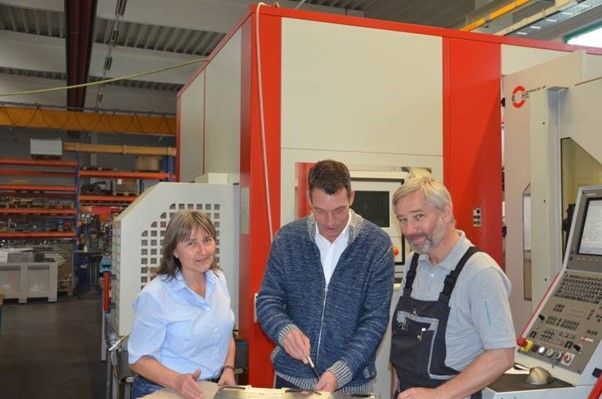
Today, twelve qualified employees work on the CNC machines, two of which are equipped with a robot for automated loading and unloading. "We can mill parts from just a few millimeters up to three and a half meters in length, according to drawings or data sets," explains Peter Dorau, describing the range of capabilities. All machines at Trissler and Kielkopf operate with Heidenhain controls. "This allows us to deploy our employees flexibly. If necessary, they can also work on other machines without having to familiarize themselves with a new control system. This arrangement provides the necessary flexibility and has proven its worth in practice," says Peter Dorau.
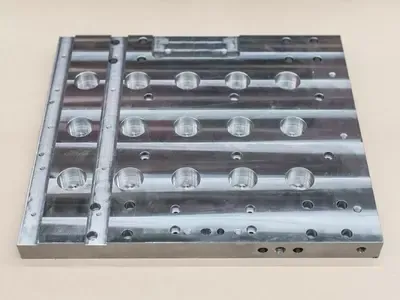
Trissler and Kielkopf continue to focus on machining parts for Stoll knitting machines. Key components include machined metal plates for the knitting machines, featuring numerous perforations into which pins are later inserted. "We receive the plates pre-machined and then handle the grinding, milling, and drilling," explains Peter Dorau. The CNC machining specialist's client list increasingly includes companies from the packaging and environmental technology industries, complemented by special-purpose machine and fixture construction. One of the strengths of this agile, medium-sized company is its high degree of flexibility. "We manufacture individual parts as well as series of 5,000 pieces and more," says Christel Dorau. Between 300 and 400 orders are processed each month.
Appealing new reamer
Trissler and Kielkopf's ability to respond flexibly to increasing and rapidly changing customer demands as well as intensified competitive conditions was also well known to Achim Schweikart of HAM Standard-Produktvertriebsgesellschaft Hartmann. The specialist for technical consulting and sales, who has maintained a good business relationship with the Reutlingen-based company for many years, was able to offer the medium-sized company a new reamer design, the development of which stemmed from a shortage. "We noticed some time ago that it was becoming increasingly difficult to obtain blanks for the production of reamers. Perhaps this market was considered too unattractive, and there were no longer any suitable offers. So we searched intensively for alternatives and succeeded in producing reamer blanks ourselves," explains Schweikart.
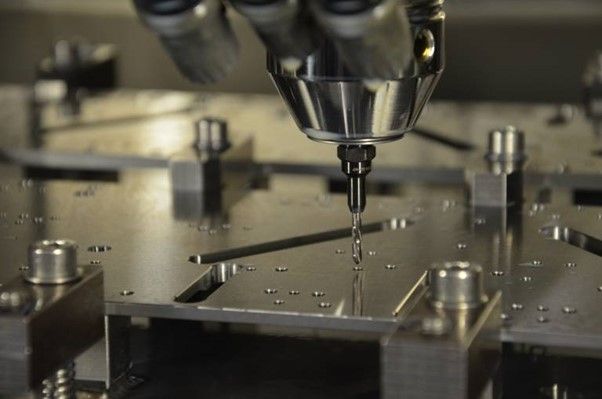
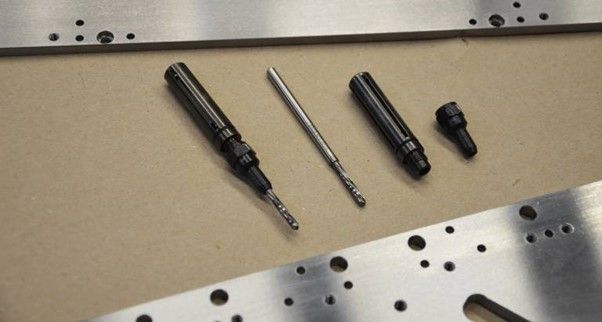
The new product consists of a specially manufactured cermet head, which is joined to a solid carbide shank using a special process. Internal cooling of the tool and collet ensures clean chip removal. "The coolant reaches the cutting edge cleanly, and the chips are reliably carried away. This is an extremely important requirement when using reamers," says Schweikart. The reamer is inserted into a collet and installed in a standard hydraulic expansion chuck. "This guarantees high concentricity." A great deal of specialized knowledge and intensive development work went into this new development. But the effort has paid off. Achim Schweikart: "With this reamer, we are the market leader." The reamers can be manufactured to customer specifications in any diameter.
The precision tool specialists conducted initial tests at knitting machine manufacturer Stoll, a long-standing Hartmann customer, as is Trissler & Kielkopf. The reaction from the global market leader was overwhelmingly positive. "They were thrilled with the test results in Reutlingen. Stoll was immediately convinced of the tools' long service life," said Schweikart. "That's why I also offered our new product to Trissler and Kielkopf."
fivefold improvement
Managing Director Peter Dorau, like his wife Christel, is open to new ideas and didn't hesitate to use the reamer to machine parts for Stoll. The results were just as good as those achieved for the client. "The whole process is now significantly faster. With diameters of 3P7 and 3E8, we're achieving feed rates of 2,500 mm/min. We've reduced the reaming machining time by a factor of five," says Peter Dorau with satisfaction. Dorau was also impressed by the reamers' durability. "With low-alloy steels such as 16MnCr5, the tool life has increased by a factor of five or more." While 5,000 to 6,000 uses per reamer before wear were typical in the past, 25,000 to 30,000 uses are now achievable before the tool needs to be replaced. Thus, the reamers from HAM Standard-Produktvertriebsgesellschaft Hartmann are being used with great success in various applications at Trissler & Kielkopf.
Christel Dorau is also enthusiastic about the innovation. "In our sector, price and competitive pressure from low-wage countries is constantly increasing. Clever solutions like these help us improve our position."